NeverBounce Alternatives: An Honest Comparison for 2026

NeverBounce is one of the best known email verification services, and most people who go looking for an alternative are not unhappy with its accuracy. They are usually reacting to one of three things: the price at low volume, the credit expiry policy, or the shift towards subscription plans. This post walks through the options honestly, including where NeverBounce is still the better answer.
Full transparency: we build ClearBounce, so we are not a neutral referee. What we can do is make every figure checkable. NeverBounce’s prices and expiry wording come from their own pricing page, ZeroBounce’s from theirs, and ours from our pricing page. Everything here was read on 9 August 2026 and providers change terms — check the source before you buy.
Why people look for a NeverBounce alternative
In the discussions we see, the reasons cluster tightly. The first is entry price: at $0.008 per verification for a small list, a one-off cleanup of 2,000 contacts costs more than some people expect for what is essentially a lookup. The second is the credit expiry rule, which we cover in detail below. The third is structural — the pricing page now leads with a $49/month Growth plan, and buyers who verify in unpredictable bursts do not want a monthly commitment.
None of those are accuracy complaints, which matters when you choose a replacement. If you switch to something cheaper that guesses more, you have traded a billing problem for a bounce rate problem, and that is a far more expensive trade.

NeverBounce pricing, in full
These are the pay-as-you-go tiers exactly as listed on the NeverBounce pricing page:
| Volume | NeverBounce | ClearBounce |
|---|---|---|
| 1,000 | $8 | $4 |
| 5,000 | $40 | $17.50 |
| 10,000 | $50 | $30 |
| 50,000 | $250 | $125 |
| 100,000 | $400 | $200 |
| 250,000 | $750 | $375 |
| 1,000,000 | $2,500 | $1,000 |
| 2,000,000 | $4,000 | Contact us |
One caveat on our own column, because a price table without it would be misleading: those are founder-discount prices that run to the end of 2026. Our undiscounted list price is double the figures above. At that price we are identical to NeverBounce at 1,000, 50,000, 100,000 and 250,000, cheaper at 5,000 and 1,000,000, and more expensive at 10,000. The durable difference between us is not the number in that table — it is what happens to credits you have not used, which is the next section.
There is also a Growth subscription at $49 per month covering up to 10,000 emails, and a custom Enterprise tier aimed at 250,000+ per month. If you are comparing on price alone, compare on the day you buy. Our pricing guide explains what actually drives cost per verification across the market.
The credit expiry question
This is the difference that costs real money and it is easy to miss. The NeverBounce pricing page states it plainly, directly under the Buy Credits button:
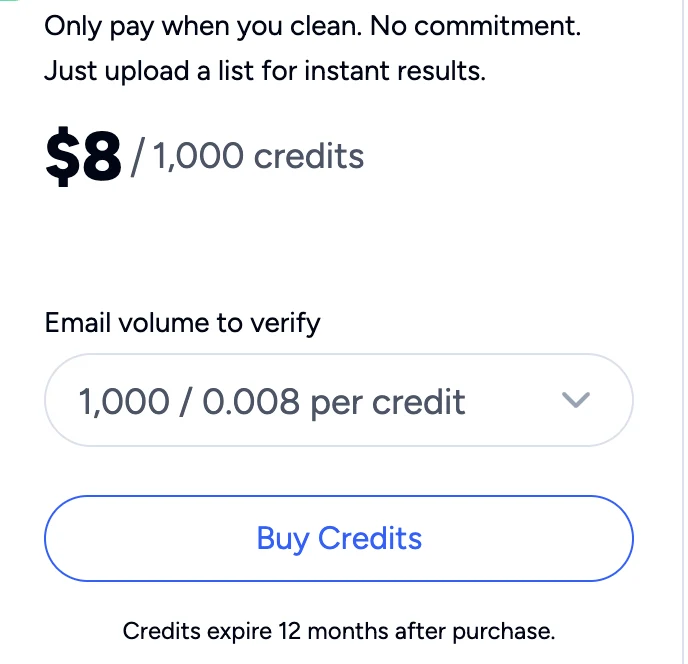
“Credits expire 12 months after purchase.” If you buy a discounted block of 100,000 to get the better unit rate and use 60,000 of it in the first year, the remaining 40,000 disappear. Your effective cost was not $0.004 per verification, it was closer to $0.0067 — more than the $0.005 you could have paid for a 10,000-credit block with no commitment at all.
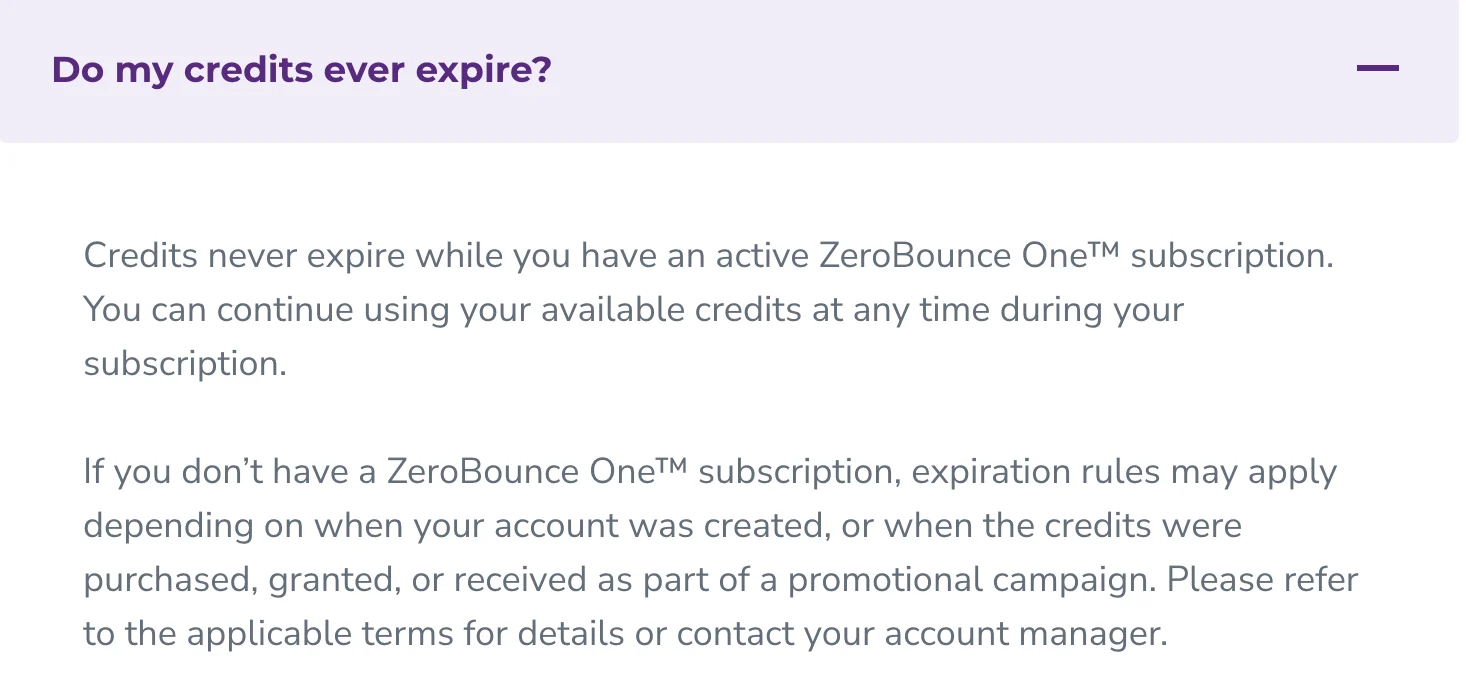
It is worth being precise about the alternatives here, because the internet repeats a simplification. ZeroBounce is widely described as having credits that never expire. Their own pricing FAQ is more conditional than that: credits never expire while you have an active ZeroBounce One subscription, and without one, “expiration rules may apply depending on when your account was created, or when the credits were purchased, granted, or received as part of a promotional campaign.” That is not a criticism — it is a reasonable policy — but it is not the same as unconditional.
ClearBounce credits do not expire and there is no subscription condition attached. That is the single most durable difference between us and NeverBounce, and unlike a discount it cannot quietly lapse.
What NeverBounce genuinely does well
An alternatives post that pretends the incumbent is bad is not useful. NeverBounce has a long track record, a mature API, and integrations with most of the platforms people actually use. Their automatic typo correction is a real feature, not marketing — catching gmai.com before it becomes a hard bounce is exactly the kind of thing that protects sender reputation.
ClearBounce
Ours, so weigh accordingly. The case for switching is narrow and specific rather than sweeping: credits that do not expire, no monthly commitment, and a real-time API plus form-level blocking in the same account, so you can stop bad addresses at signup rather than cleaning them up later.
Where we are weaker: we are younger, we have fewer third-party audits than the incumbents, and our integration list is shorter than NeverBounce’s even though the common ones (Zapier, Make, HubSpot, Mailchimp and the rest) are covered. If procurement at your company requires a long vendor history, that is a real obstacle and we would rather you know it now.
ZeroBounce
The broadest product line of the group. Alongside verification their own pricing page lists AI scoring and an email finder, each drawing on the same credit pool. If you want a single vendor and the budget is there, that consolidation has real appeal. Two things to weigh against it. The credit terms are tied to an active subscription, as described above. And several of the pieces people assume require buying a suite — inbox placement testing, blocklist monitoring across Spamhaus, Barracuda, SpamCop and others, plus SPF, DKIM and DMARC checks — are already in our Deliverability Kit, so “one vendor for everything” is not on its own a reason to move. We compare the two directly in ClearBounce vs ZeroBounce, and there is a head-to-head of ZeroBounce vs NeverBounce if you are choosing between exactly those two.
Kickbox
The strongest choice when compliance is the deciding factor. Kickbox is SOC 2 certified, has been in the market a long time, and offers human deliverability consulting rather than a chat widget. Pricing starts lower than NeverBounce at the smallest tier. If your buyer is an enterprise security team rather than a marketer, that certification does more work than any feature comparison. Our full write-up is in ClearBounce vs Kickbox.
The budget end of the market
MillionVerifier and similar low-cost providers are priced well below the names above, and for a one-off cleanup of a list you already trust, that can be the right call. The thing to test before you commit is how they report catch-all domains. This is the category where verification tools disagree most, and a provider that quietly folds catch-alls into “valid” will show you a flattering summary and then bounce. Run the same sample through two tools and compare the disputed rows — half an hour of work that tells you more than any review site.

How to choose between them
Pick on the constraint that actually binds you, not on the feature grid:
- Verifying in unpredictable bursts? Expiry terms matter more than unit price.
- Steady monthly volume? A subscription is genuinely cheaper and expiry is irrelevant.
- Compliance-led purchase? Certification beats everything else on the list.
- Fixing a problem at the source? You want validation at signup, not a bigger list-cleaning budget.
- One-off cleanup of a known list? Cheapest credible option wins.

Whatever you choose, verification only removes addresses that cannot receive mail. It does not make an uninterested subscriber interested, and it will not repair a damaged sending reputation — a clean list can still land in spam. Anyone selling you verification as a deliverability cure, us included, is overselling it.
Frequently asked questions
Do NeverBounce credits really expire?
Yes. Their pricing page states that credits expire 12 months after purchase. It applies to pay-as-you-go credit purchases, so it matters most if you buy a large discounted block and use it slowly.
Which alternative is cheapest?
At the budget end, providers like MillionVerifier are priced well below the established names. Among the established options the list prices are closer than most comparison posts suggest — at 1,000 verifications NeverBounce and our own list price are both $8. Compare on the day you buy, and factor in whether unused credits survive the year.
Is it worth switching if accuracy is my only concern?
Probably not on its own. Take a list where you already know what bounced, run it through the candidates on their free credits, and compare against the real outcome. That measures accuracy on your data instead of on a vendor’s claim about it.
Can I move without losing my existing integrations?
Usually yes. Most verification providers, including us, expose a REST API and connect through Zapier and Make, so an existing automation normally needs its verification step swapped rather than rebuilt.