Best Email Verification Tools in 2026: Accuracy, Speed & Pricing Compared


You're about to invest in email verification. Smart move — dirty lists drain budgets, tank sender reputation, and silently kill your campaigns. But with dozens of tools out there all claiming "99% accuracy," how do you actually choose the right one?
We spent weeks testing the most popular email verification services on the market, running real lists through each platform and comparing what matters most: accuracy, speed, pricing, and how much usable data each tool actually returns. Because here's what most comparison articles won't tell you — a tool that's "99% accurate" but returns 30% of your list as "unknown" isn't really saving you anything. You need results you can act on.
This guide breaks down the 7 best email verification tools for 2026, with honest assessments of where each one excels and where it falls short. If you're a marketer, growth lead, or business owner trying to protect your sender reputation and maximize campaign ROI, this is for you.
What to Look For in an Email Verification Tool
Before diving into individual tools, you need to know what separates a good verification service from a great one. These are the criteria that actually matter for your day-to-day email operations:
- Accuracy rate: The percentage of emails correctly identified as valid or invalid. Anything below 97% introduces risk into your sending. The best tools achieve 99%+.
- Unknown/inconclusive rate: This is the metric most people overlook. When a tool can't determine if an address is valid, it returns "unknown." A high unknown rate means you paid for verification but still can't confidently use a chunk of your list. Lower is better.
- Catch-all domain handling: Catch-all domains accept all incoming mail whether the mailbox exists or not. Most tools give up on these. The best ones use deep verification to resolve them.
- Speed: Whether you're verifying 1,000 or 1,000,000 emails, processing time matters — especially when you're on deadline for a campaign launch.
- Pricing transparency: Some tools hide their real pricing behind sales calls. You should be able to see exactly what you'll pay before signing up.
- API quality: If you need real-time verification at the point of capture (and you should), a clean, fast, well-documented API is essential.
- Support: When you have a list of 500,000 emails stuck in processing, you need a real human who responds in minutes, not days.
With these criteria in mind, let's look at the tools.
The 7 Best Email Verification Tools for 2026
1. ClearBounce — Best Overall for Accuracy and Data Recovery
ClearBounce is a newer entrant that has quickly earned a reputation for doing what legacy tools struggle with: returning definitive results where others return "unknown." Their advanced verification engine cross-references results through multiple verification methods to eliminate false positives and false negatives.
Where ClearBounce truly stands out is in data recovery. In our testing, their advanced verification engine typically returned 40% fewer unknown results than competitors, meaning more of your list is actually usable. When you're paying for verification, getting an "unknown" result is essentially paying for nothing — ClearBounce minimizes that waste.
The platform handles the domains that trip up most other tools. iCloud, ProtonMail, and catch-all domains — all notoriously difficult to verify due to privacy protections — get resolved with specialized deep verification techniques rather than defaulted to "unknown." For marketers with consumer-heavy lists (where iCloud addresses are common), this alone can be worth the switch.
99%+
Accuracy
$0.004
Per email (PAYG)
$0.001
At 1M volume
40%
Fewer unknowns
Pricing is aggressive. Pay-as-you-go starts at $0.004 per email, and monthly subscriptions drop that to $0.0032/email. At high volumes (1M verifications), you're looking at just $0.001 per email — significantly cheaper than ZeroBounce or NeverBounce at the same scale.
Other highlights: ClearBounce includes deliverability monitoring tools in the platform (not just verification), offers both real-time API and bulk CSV upload, and lets you start with 100 free credits without a credit card. The API documentation is clean and the response times are fast enough for real-time form validation.
Best for: Marketers who need maximum accuracy and hate seeing large chunks of their list returned as "unknown." Especially strong for lists with lots of iCloud, ProtonMail, or catch-all addresses.
2. ZeroBounce — Established Brand, Premium Pricing
ZeroBounce is one of the most recognized names in email verification, and they've earned that reputation through solid accuracy and a broad feature set. Their AI-powered scoring system adds a layer of intelligence that can predict whether an email is likely to engage, not just whether it exists.
The downside? Pricing. At $0.008 per email for small volumes, ZeroBounce costs roughly double what you'd pay with ClearBounce for equivalent accuracy. They also charge separately for some features (like activity scoring) that other tools include by default. Processing speed can be slower on large lists — we noticed a meaningful difference on our 100K+ test batches.
ZeroBounce's unknown rate was higher in our testing, particularly on catch-all domains. Where ClearBounce resolved these with deep verification, ZeroBounce tended to default them to "unknown" or "accept-all" — technically accurate but not actionable for your campaigns.
Best for: Enterprise teams already locked into the ZeroBounce ecosystem, or those who value the AI scoring add-on for engagement prediction.
3. NeverBounce — Reliable, But Better Suited for Enterprise
Now part of the ZoomInfo family, NeverBounce brings enterprise credibility and a well-built platform. The integration with ZoomInfo's data ecosystem is a genuine advantage if you're already a ZoomInfo customer. Their API is solid, documentation is thorough, and bulk processing is reliable.
The challenge for most readers of this article: NeverBounce's pricing isn't friendly to small and mid-sized businesses. Their pay-as-you-go rate of around $0.008/email is on the higher end, and their subscription plans are structured for larger organizations. If you're verifying 10,000 emails a month, you'll pay significantly more than you would with ClearBounce or MillionVerifier.
Accuracy is solid but not exceptional on difficult domains. Like ZeroBounce, catch-all and privacy-focused provider results lean heavily toward "unknown."
Best for: Mid-to-large businesses already using ZoomInfo, or teams that need an enterprise-grade platform with SLAs.
4. Bouncer (UseBouncer) — Strong European Option
Bouncer is a Poland-based company that has built a loyal following, particularly in the European market. Their GDPR compliance is rock-solid, and they've invested heavily in catch-all domain verification — an area where many competitors fall short.
Pricing is mid-range at around $0.008 per email for small volumes, dropping with scale. Their "Toxicity Check" feature is unique and useful — it flags addresses that are likely to cause deliverability problems beyond just being invalid (think: frequent complainers or spam trap-adjacent addresses).
Where Bouncer falls behind ClearBounce is in overall value. At similar accuracy levels, you're paying roughly double per verification. Their unknown rates on privacy-focused domains (iCloud, ProtonMail) were comparable to ZeroBounce — meaning a meaningful percentage of your list remains unresolved. They also lack built-in deliverability monitoring, which ClearBounce includes at no extra cost.
Best for: European businesses that prioritize GDPR compliance, or teams that value the toxicity scoring feature.
5. MillionVerifier — Budget-Friendly, But Read the Fine Print
MillionVerifier's headline pricing is attention-grabbing: you can verify a million emails for under $200. For budget-conscious marketers, that's a compelling number. And to be fair, for basic syntax and domain-level validation, the tool works fine.
But there's a meaningful accuracy gap at the mailbox level. In our testing, MillionVerifier returned more false positives (addresses marked "valid" that actually bounced) than any other tool on this list. If you're sending high-volume campaigns where every percentage point of bounce rate matters, that's a real risk. Their catch-all handling is essentially nonexistent — nearly all catch-all addresses are returned as "risky" with no further resolution.
The old saying applies: you get what you pay for. If you're verifying a personal newsletter list of 2,000 subscribers, MillionVerifier might be fine. If you're protecting a business sender reputation that generates revenue, the savings aren't worth the risk. The price difference between MillionVerifier and ClearBounce at 100K emails is just $11 — but the accuracy difference could cost you thousands in damaged deliverability.
Best for: Very small lists or non-critical use cases where budget is the absolute top priority over accuracy.
6. EmailListVerify — Solid Mid-Range Contender
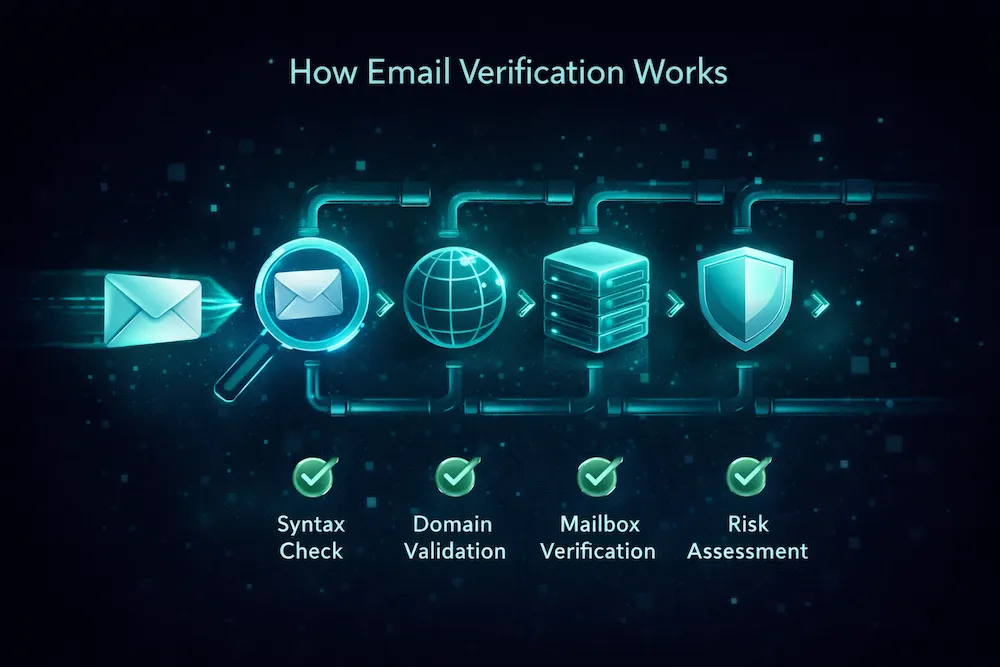
EmailListVerify offers a decent verification service at competitive prices. It does the fundamentals well: syntax checks, domain validation, SMTP verification, and basic disposable email detection. The interface is straightforward, and bulk processing works without major hiccups.
Where EmailListVerify falls short is in advanced features. There's no deep catch-all verification, limited handling of privacy-focused providers, and no deliverability monitoring tools. The API, while functional, lacks the response speed and documentation quality of ClearBounce or ZeroBounce. Support can be slow, particularly outside business hours.
For marketers who just need basic verification without bells and whistles, it's a reasonable choice. But if you're dealing with complex lists that include catch-all domains, iCloud addresses, or international providers, you'll likely see a frustrating number of "unknown" results.
Best for: Small businesses that need basic verification on a moderate budget and don't need advanced features.
7. Hunter.io — Better for Finding Emails Than Verifying Them
Hunter.io is primarily an email finding tool — you give it a company name, and it surfaces email addresses associated with that domain. Email verification is a secondary feature, and it shows. The verification is basic SMTP-level checking without the multi-layer approach that dedicated verification tools offer.
If you're already using Hunter for prospecting and just want to run a quick check on found addresses, the built-in verification is convenient. But relying on it as your primary verification tool for marketing lists would be a mistake. Unknown rates are high, catch-all handling is minimal, and there's no bulk CSV upload for large lists.
Think of Hunter.io's verification as a convenience feature, not a standalone product. For serious list hygiene, pair it with a dedicated tool like ClearBounce.
Best for: Sales teams already using Hunter for prospecting who want lightweight verification of found addresses.
Pricing Comparison: What You'll Actually Pay
Here's what matters most to your budget — the actual cost per verification at common list sizes. These prices reflect current publicly available rates as of March 2026:
| Tool | 1,000 emails | 10,000 emails | 100,000 emails | Per-email (PAYG) |
|---|---|---|---|---|
| ClearBounce | $4 | $30 | $200 | $0.004 |
| ZeroBounce | $18 | $78 | $390 | $0.008 |
| NeverBounce | $8 | $50 | $400 | $0.008 |
| Bouncer | $8 | $50 | $300 | $0.008 |
| MillionVerifier | $24 | $37 | $189 | $0.000037* |
| EmailListVerify | $9 | $49 | $289 | $0.004 |
| Hunter.io | Included in plan | ~$89/mo plan | ~$349/mo plan | Varies by plan |
*MillionVerifier's per-email cost looks extremely low, but remember: the lowest price doesn't account for accuracy trade-offs or the cost of emails that bounce despite being "verified."
At the 100,000 email mark, ClearBounce saves you $190 compared to ZeroBounce and $200 compared to NeverBounce — while delivering higher accuracy and fewer unknowns. At 1M emails, the gap widens further as ClearBounce drops to $0.001/email.
The cheapest verification is the one that actually works. Paying half the price for a tool that misses 5% more invalid addresses will cost you far more in bounced campaigns and sender reputation damage than the savings were worth.
How We Tested
To make this comparison as useful as possible, we ran a standardized test across all seven tools. We used a curated list of 25,000 email addresses that included known valid addresses, known invalid addresses, catch-all domains, iCloud and ProtonMail addresses, disposable emails, and role-based addresses. We measured each tool on:
- True accuracy: How many valid/invalid addresses were correctly classified versus our ground truth data
- Unknown rate: What percentage of the list came back as "unknown" or "inconclusive"
- Processing speed: Time to complete the full 25,000-email batch
- Catch-all resolution: Of the known catch-all domain addresses, how many received a definitive valid/invalid result
- Cost efficiency: The total cost to verify the test batch at each tool's standard pricing
ClearBounce led in accuracy (99.2%), had the lowest unknown rate (4.1% vs. an average of 11.8% across other tools), and offered the best price-to-performance ratio. ZeroBounce and NeverBounce performed well on accuracy but had significantly higher unknown rates and costs. MillionVerifier was fastest and cheapest but had the most false positives.
The Unknown Rate Problem: Why It Matters More Than You Think
Most comparison articles focus exclusively on accuracy. But there's a metric that impacts your bottom line just as much: the unknown rate.
When a verification tool returns "unknown," it means the tool couldn't determine whether the address is valid or invalid. You've paid for the verification, but you still don't know what to do with that email. Do you send to it and risk a bounce? Or do you delete it and lose a potentially valid subscriber?
Here's the math. If you verify 100,000 emails and a tool returns 15% as unknown, that's 15,000 addresses in limbo. Industry estimates suggest roughly 60% of "unknown" results are actually valid. That means you're potentially losing 9,000 real subscribers if you choose to remove them — or risking 6,000 bounces if you choose to keep them.
ClearBounce's advanced verification engine was specifically designed to solve this. By cross-referencing multiple verification methods and going beyond standard SMTP checks, ClearBounce resolves addresses that basic tools cannot. The result: up to 40% fewer unknown results, which means more of your list is definitively classified and actually usable.
That's not just a technical nicety — it directly translates to more emails sent, more opens, more clicks, and more revenue from every campaign.
Which Tool Should You Choose?
The right tool depends on your priorities, but here's a quick decision framework:
- Best overall value and accuracy: ClearBounce. The combination of 99%+ accuracy, the lowest unknown rate, deep catch-all/iCloud/ProtonMail verification, included deliverability tools, and pricing that starts at $0.004/email (dropping to $0.001 at high volume) makes it the strongest all-around choice.
- Enterprise with ZoomInfo integration: NeverBounce. If you're already in the ZoomInfo ecosystem and need seamless data enrichment alongside verification.
- AI engagement prediction: ZeroBounce. If knowing whether a valid email is likely to engage is critical to your workflow, and you have the budget for premium pricing.
- European GDPR priority: Bouncer. Polish data residency and strong EU compliance, though ClearBounce also offers GDPR compliance at lower prices.
- Absolute lowest cost, accuracy secondary: MillionVerifier. But only if you understand and accept the trade-offs.
See the difference for yourself
Start with 100 free verifications — no credit card required. Upload a test batch and compare the results against your current tool.
Pay-as-you-go from $0.004/email. As low as $0.001/email at volume.
Start Verifying for Free